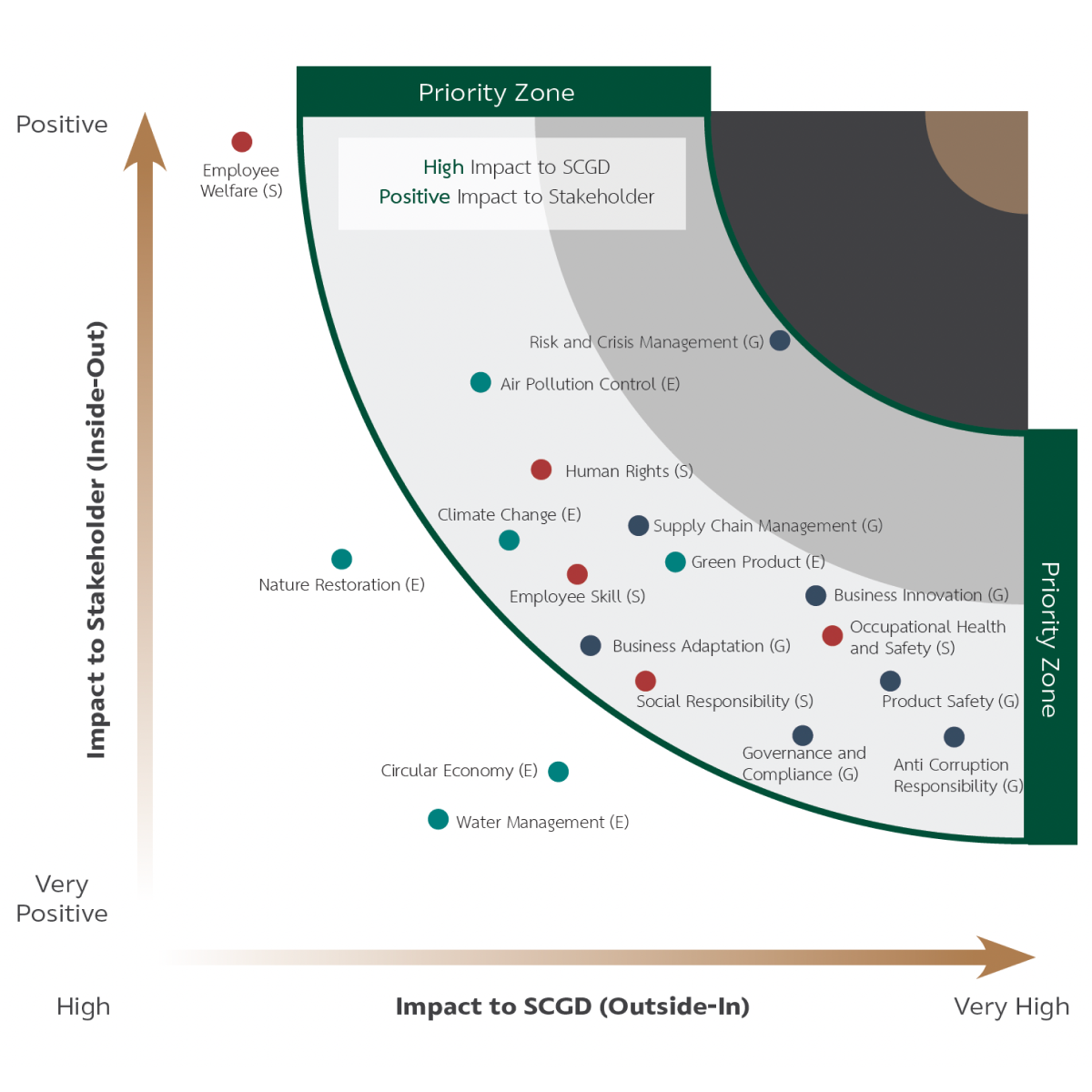
Materiality Analysis
The Company conducts a sustainability materiality assessment based on the Double Materiality principle, considering both the organizational context and insights gathered from stakeholder engagement. This assessment evaluates: Inside–out impacts: the Company’s impacts on stakeholders, society, and the environment, and Outside–in expectations: stakeholder expectations and external factors that may influence the Company’s business performance.
The materiality assessment covers issues across the Environmental (E), Social (S), Governance and Economic (G) dimensions. Each topic is prioritized and aligned with the United Nations Sustainable Development Goals (SDGs) to ensure relevance to global sustainability frameworks.
Material topics identiųed as signiųcant to the Company are incorporated into the enterprise risk management process and the Company's strategic and operational planning. In addition, the Company has established a policy to review its material sustainability topics every two years to ensure continued relevance amid changing business conditions, social expectations, and environmental challenges.
Process for Double Materiality Analysis
Value Chain Analysis
Context Identification
Stakeholder Survey
Inside Out / Outside In Analysis
Materiality Prioritizing
Stakeholder and Considered Contexts
Stakeholder from Value Chain Company Contexts
Environment Social Governance
  1. Customer
  2. Investor
  3. Employee
  4. Community
  5. Contractor Labor
  6. Government Agency
  7. Supplier
  8. Distributor
  9. Media
  10. Academic And Civil Society
  1. Climate Change
  2. Green Product
  3. Circular Economy
  4. Water Management
  5. Air Pollution Control
  6. Nature Restoration
  1. Employee Welfare
  2. Employee Skill
  3. Human Rights
  4. Social Responsibility
  5. Safety & Occupational Health
  1. Anti-Corruption
  2. Risk and BCM
  3. Governance and Compliance
  4. Product Safety
  5. Supply Chain Management
  6. Business Innovation
  7. Business Adaptation
Result of Double Materiality Analysis
Prioritize Materiality and Management approaching for each context
The Company has prioritized Materiality and Management approaching for each context as following (Additional information in Annual Report 2025 (Form 56-1 One Report))
Contexts Priority Main Stakeholder Related SDGs Approaching
Climate Change Strategy (E)
Government/Distributor/Customer/Community
Detail on page 112
Green Product (E)
Customer/Distributor/Community
Detail on page 108
Air Pollution Control (E)
Community/Government/Media/NGO
Detail on page 121
Circular Economy (E)
Supplier/Community/Customer/Government
Detail on page 123
Nature Restoration (E)
Government/Community
Detail on page 125
Water Management (E)
Community/Government/NGO/Media
Detail on page 119
Occupational Health and Safety (S)
Employee/Contractor/Community
Detail on page 126
Social Responsibility (S)
Community/NGO/Media
Detail on page 138
Employee Skill (S)
Employee/Contractor
Detail on page 148
Human Rights (S)
Employee/Contractor
Detail on page 130
Employee Welfare (S)
Employee/Community
Detail on page 142
Risk and Crisis Management (G)
Investor/Community/Supplier/Distributor
Detail on page 67
Anti-Corruption Responsibility (G)
Investor/Community/Supplier/Distributor/Government
Detail on page 284
Product Safety (G)
Customer/Government
Detail on page 152
Business Innovation (G)
Customer/Investment
Detail on page 153
Governance and Compliance (G)
Government/Investor
Detail on page 283
Supply Chain Management (G)
Supplier/Distributor/Customer
Detail on page 154
Business Adaptation (G)
Investor
Detail on page 31